Joanna Rajkowska
“Night Herons”
Joanna Rajkowska, Robert Yerachmiel Sniderman, Night Herons, 2020–2021
film, 37 min 18 s, edition 2/5 + 2 AP
Collection II of the Arsenal Gallery in Białystok. Work purchased by the Arsenal Gallery in 2025
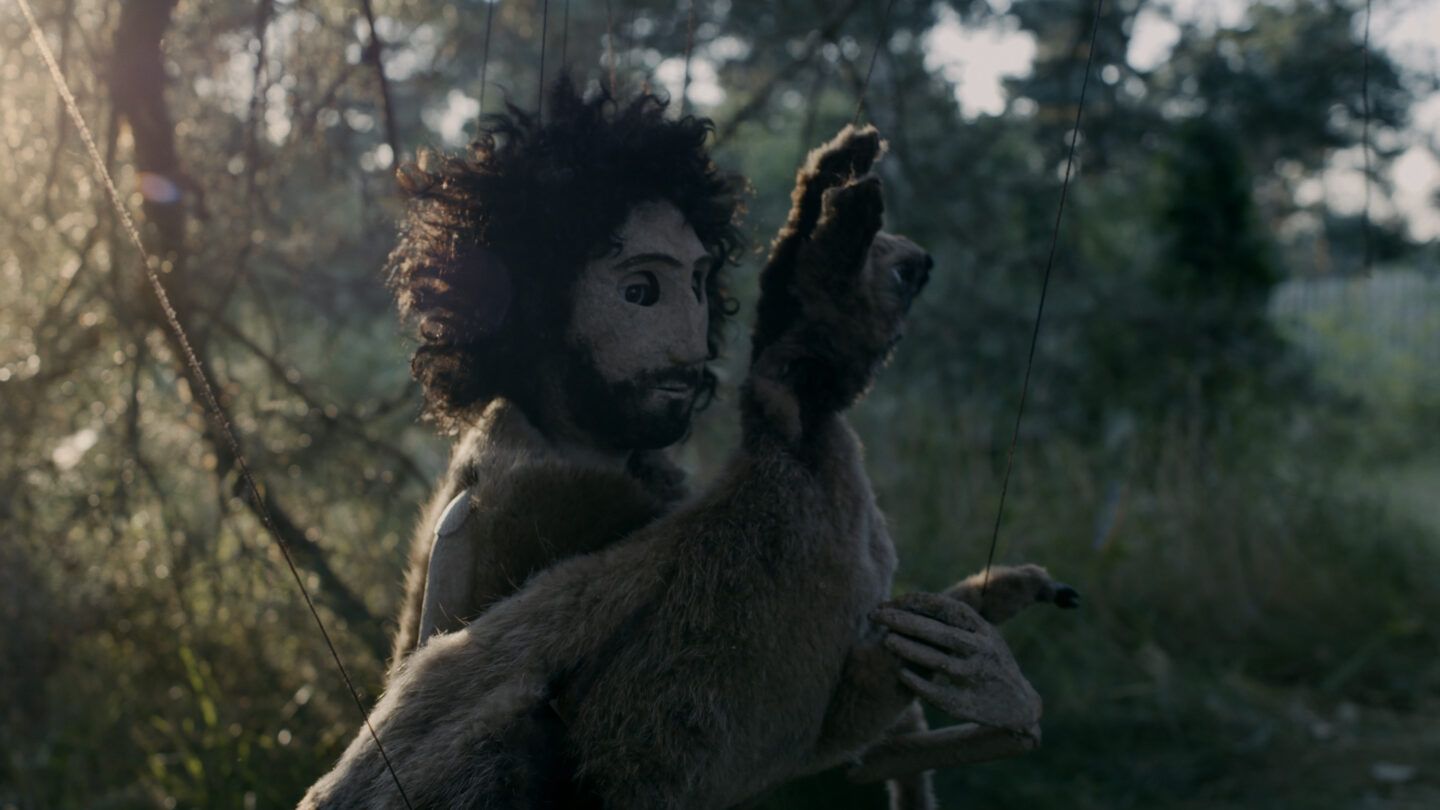
In their autobiographical film “Night Herons“, Joanna Rajkowska and Robert Yerachmiel Sniderman interweave the fates of their families and the harrowing experiences of several generations. The film opens with the scene of Sara bat Moshe wandering through a marshy forest, carrying garlic, which is to protect her from illness and demons, and a dead cockerel that possesses the power to ‘redeem the soul of this place’. It is her grandson whom the granddaughter of Zelik, owner of a fashionable clothes shop – and Sniderman’s great-grandfather – will marry. Also making their way through the marshes are fugitives from a transport to Auschwitz: a mother with her young son Dzidek; they are Rajkowska’s grandmother and father. Concepts proposed by Baruch Spinoza are the film’s unifying thread: it opens with the statement ‘All bodies agree in certain respects’, a lemma to Proposition XIII in the second part of his “Ethics“, and closes with a dance set to the words of the anathema imposed on the philosopher by the Amsterdam Jewish community.
The oneiric narrative of tragic fates is spun by marionettes representing humans and animals. The former are used in a subversive manner: rather than traditionally representing human passivity, they serve to work through trauma and – in keeping with Spinoza’s philosophy – to blur the differences between human beings and the natural world. The human and animal puppets have been crafted using the same technique, from similar organic materials. This approach erases the ontological difference between the human body and the animal body: in the face of marshes, forests and shared suffering, the death of a human and that of an animal become equivalent experiences. In a film dedicated to all animals that have been killed, Spinoza’s concept and the figure of the puppet make it possible to weave human dramas and violence wrought against Nature, and especially against animals, into a single narrative.
According to Slavic beliefs, night herons – birds that spend their days in the reeds and search for food at night – serve the souls of the dead as their guides. Hidden in the thicket of the marsh, they bear witness to human tragedies. Dzidek, who had to survive among other creatures, returns to the forest years later as a hunter, bringing his trophies back to his small flat. Taking on the role of the tormentor helps him cope with his trauma as a victim. The film concludes with a scene depicting the burial of the hunted animals. Human puppets wash the ‘dead’ bodies of animal puppets, dress their wounds, comb their fur and wrap them in shrouds. The transposition of human funeral rites onto animal puppets is a symbolic attempt at atonement for the cruelties inflicted on Nature by humankind.
Izabela Kopania
Translated from Polish by Klaudyna Michałowicz
Co-financed from the means of the Minister of Culture and National Heritage of the Republic of Poland coming from the Fund for the Promotion of Culture – a state special-purpose fund
Carried out from the City of Białystok budget
PLAN YOUR VISIT
Opening times:
Thuesday – Sunday
10:00-18:00
Last admission
to exhibition is at:
17.30