Janek Simon
A Man with a Dog’s Head, 2015
Janek Simon, A Man with a Dog’s Head, 2015, 5 sculptures, 3D print, PLA polymer, 47 × 17 × 15 cm
Collection II of the Arsenal Gallery in Białystok. Works purchased by the Arsenal Gallery in Białystok in 2024 (3 sculptures) and 2025 (2 sculptures)
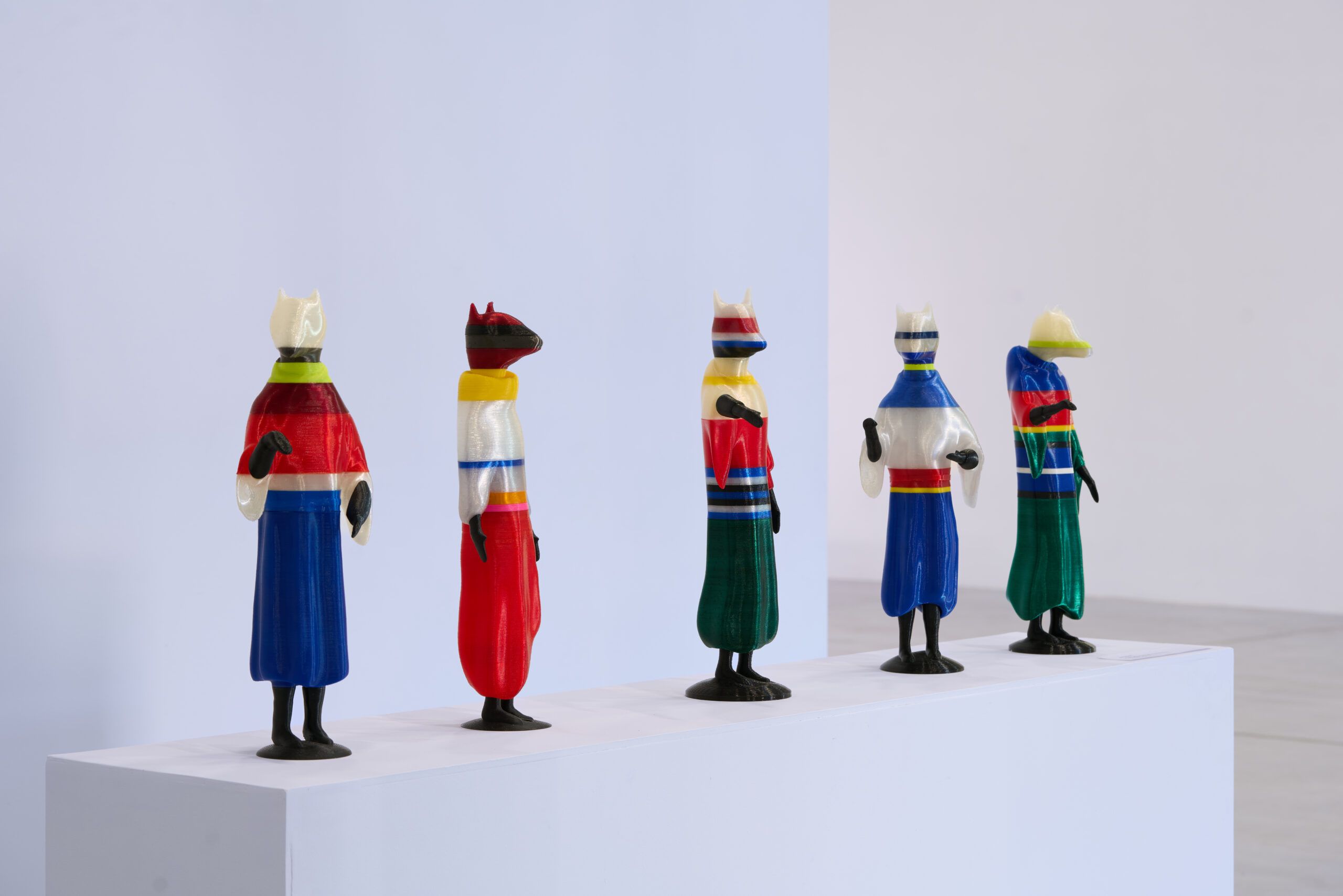
Janek Simon printed these five hybrid figures on his home 3D printer. The objects defy a clear-cut definition. Their form, colour scheme, material and ambiguous purpose play tricks on the viewer’s perception. Associations point towards decorative objects produced by Polish pottery workshops, such as the stylised animal figurines made in Ćmielów. The colour palette also seems familiar from some indeterminate designs, while the arrangement of stripes inevitably brings to mind rugs, bedspreads, and folk and ethnic costumes. Yet, after just a brief glance, these associations prove to be inconsistent, and the viewer eventually discerns a simplified figure with a human torso and a head resembling that of a dog: an animal-human hybrid that has been present in the collective imagination for centuries.
Simon drew inspiration for his works from an illustration featured in “The Travels of Marco Polo“, the tales of the Marco Polo’s journey to the East, recorded by the Italian writer Rustichello of Pisa in the late thirteenth century. The illustration showed a “cynocephalus“, a creature with the torso of a man and the head of a dog. These mythical beings, often described as barbarians and sometimes even as cannibals, were already known to the ancient world. Pliny the Elder mentioned the Cynocephali in his “Natural History“, describing them as a tribe inhabiting the mountainous regions of India. Marco Polo allegedly encountered them in the Andaman archipelago during his journey to East Asia.
The figures created by Simon represent an interpretation of medieval conceptions concerning the non-European world. In distant corners of the globe, medieval and early modern travellers, writers and illustrators sought peoples who were different from themselves. They often assumed that members of those distant tribes had strange bodies; bodies that, in reality, did not exist. The physiognomies and statures of those faraway creatures, so different from those of Europeans, were supposed to reflect their superhuman powers. Marco Polo is regarded as both a great traveller and an equally great fabulist. Inspired by his tales, Simon’s sculptures offer a commentary on the mechanisms of pre-modern invention of the Other. The figures, reminiscent of the gods of the ancient Egyptian pantheon, such as Anubis, depicted with the head of a jackal, can be seen as a reference to the attempts to scientifically rationalise early-modern conceptions. It was precisely in the images of Egyptian gods that scholars sought the prototype of the Cynocephali.
Izabela Kopania
Translated from Polish by Klaudyna Michałowicz
Janek Simon, born 1977, artist, curator, researcher, activist, lives and works in Warsaw. He studied sociology and psychology at the Jagiellonian University. He did not receive any formal art education. In his works, Janek Simon is inspired by scientific theories and models, as well as fields of knowledge such as geography and economics, which evolve with changes in civilization.
Simon’s installations and objects are often based on mathematical, physical and statistical data. At the same time, these works have an experimental and anarchic dimension, illustrating the clash between scientific theories and the reality of everyday life, current sociological and political phenomena. A number of the artist’s realisations, often incorporating complex electronic circuits, are created according to the DIY principle, which consciously seeks alternative strategies to contemporary mass culture and the prevailing system of artistic production.
Co-financed from the means of the Minister of Culture and National Heritage of the Republic of Poland coming from the Fund for the Promotion of Culture – a state special-purpose fund
Carried out from the City of Białystok budget
PLAN YOUR VISIT
Opening times:
Thuesday – Sunday
10:00-18:00
Last admission
to exhibition is at:
17.30