Anna Hulačova
Kołchoz
Anna Hulačova, Kolkhoz, 2019, concrete, pencil drawing on sheet metal, 49 × 52 × 33 cm. Collection II of the Arsenal Gallery in Białystok. Work purchased by the Arsenal Gallery in 2024
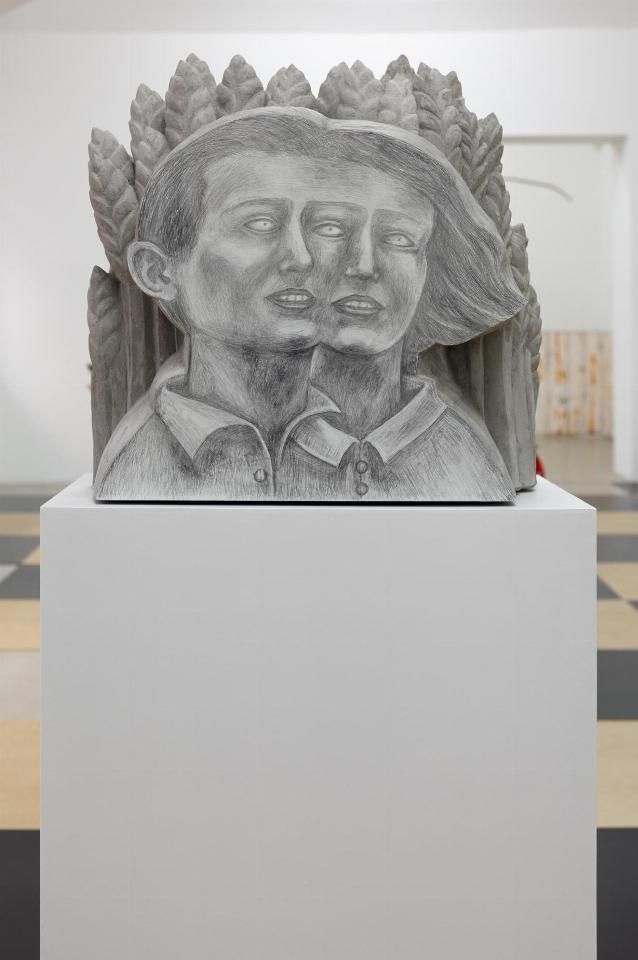
“Kolkhoz” is one of the works through which Anna Hulačova grapples with her own roots, the troubled history of the country in which she grew up, and the consequences of the policies implemented as part of the Socialist Realist vision of modern agriculture. Born in Czechoslovakia in 1984, Hulačova grew up in the countryside. Her artistic explorations have largely been defined by her experiences of working in the fields, playing with clay in her grandfather’s brickyard, exploring her aunt’s apiary and learning woodworking in her carpenter father’s workshop. Although she was able to observe first-hand the effects of the Velvet Revolution (1989) rather than the collectivisation of agriculture introduced in 1948, it was the latter that became the starting point for her reflections.
The title of the work refers to the Soviet model on which the Czechoslovak agricultural production cooperative (Czech JRD, Slov. JZD) was based: a large collective farm created through the forced amalgamation of private land. Although, following the Prague coup in February 1948, the communist authorities declared that there would be no kolkhozes in Czechoslovakia, they very vigorously pursued the collectivisation of the countryside. As farms based on monoculture, seeking to increase productivity through the use of artificial fertilisers, pesticides and heavy machinery, the kolkhozes gradually contributed to environmental degradation. This process was not halted by the change of political system, the privatisation of farms or the reorganisation of food production. This ecological aspect of her country’s socio-political past is very important to Hulačová.
“Kolkhoz” is a concrete structure resembling a sculptural monument. Hulačová has placed a double portrait, drawn in pencil on sheet metal, against a backdrop of lush ears of grain. The portrait consists of the joined busts of a woman and a man, their faces merging into one another; they share a single eye and have identical features, differing only in the length of their hair. Devoid of any distinct individuality, these figures reflect the idea of collectivisation, underpinned by the standardisation of agriculture. Artistic techniques employed by Hulačová render this sculpture a ‘monument à rebours’. In the drawn sections, her style is close to the polished hyperrealist style of Socialist Realist art. The material and colour scheme of the work emphasise its dystopian message, drawing attention to the catastrophic consequences of socio-economic and political experiments.
Izabela Kopania
Translated from Polish by Klaudyna Michałowicz
Co-financed from the means of the Minister of Culture and National Heritage of the Republic of Poland coming from the Fund for the Promotion of Culture – a state special-purpose fund
Carried out from the City of Białystok budget
PLAN YOUR VISIT
Opening times:
Thuesday – Sunday
10:00-18:00
Last admission
to exhibition is at:
17.30